

Why do your bolts—despite having the same specifications—always break at the nut?
In the world of bolted connections, the nut is often seen as a supporting character—unassuming, yet absolutely vital. The heavy hex nut, in particular, takes on the most demanding tasks within this family of components. When a connection must withstand extreme preload, severe vibration, or harsh corrosive environments, a standard nut is simply not enough. The heavy hex nut becomes the only reliable choice. Its practicality rests on four pillars: dimensional advantages, material compatibility, correct selection, and proper installation practices.
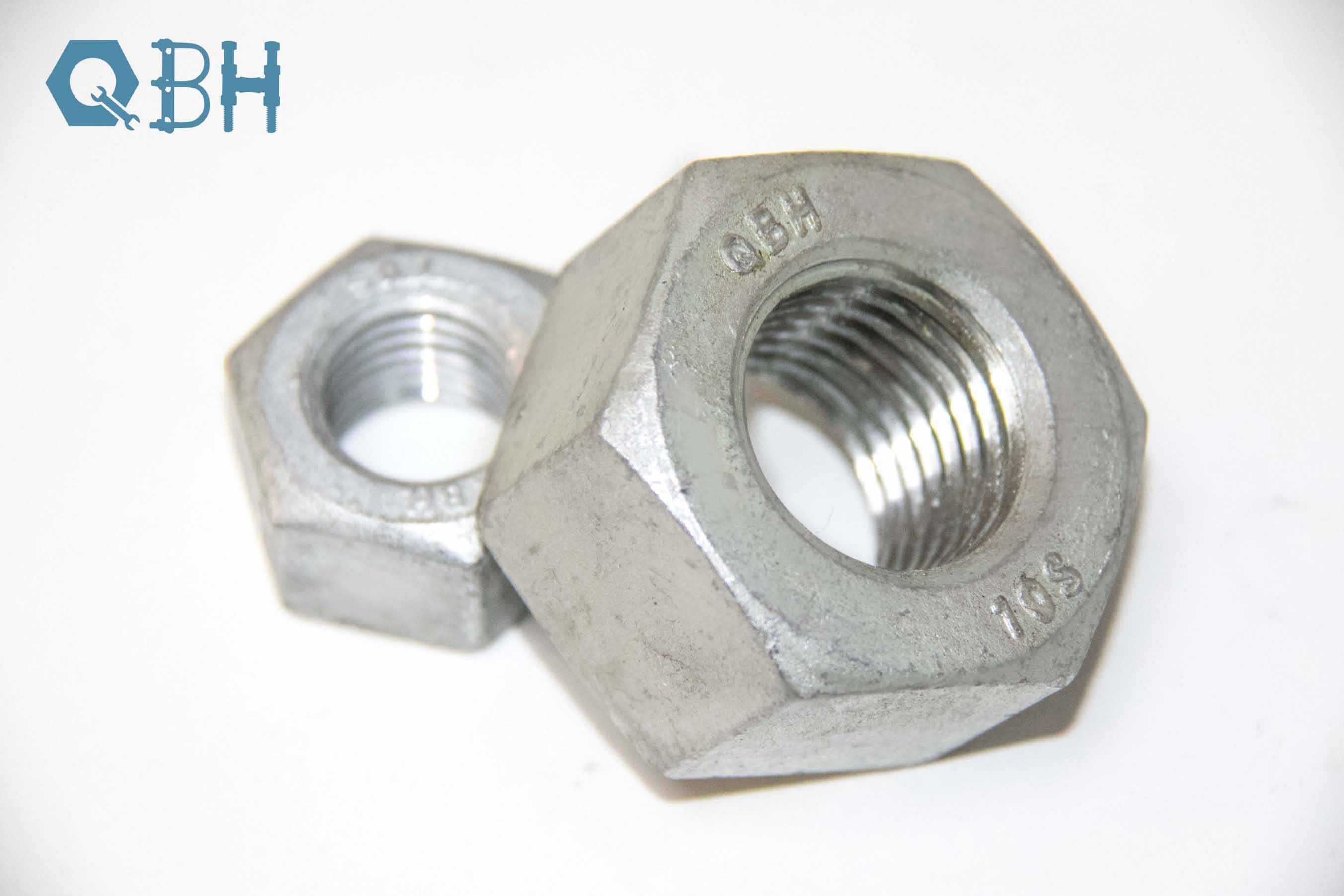
What Is a Heavy Hex Nut
A heavy hex nut, as the name suggests, is a larger, thicker, and stronger nut than the standard hex nut. It is manufactured to heavy series dimensional standards, with two defining characteristics:
-
Larger width across flats: Compared to a standard nut of the same nominal size, the heavy hex nut has a greater across-flats dimension, providing more contact area for the wrench and reducing the risk of slippage when torque is applied.
-
Greater nut height: The increased thread engagement length enhances the load-carrying capacity and resistance to loosening of the entire bolted joint.
Compared to standard nuts, heavy hex nuts offer significantly greater width across flats and nut height. For example, for a 1-inch nominal diameter nut, the standard nut has a width across flats of 1.5 inches and a height of 0.875 inches, while the heavy hex nut measures 1.625 inches across flats and 1.0625 inches in height. This translates to higher load capacity, better fatigue resistance, and more efficient torque transmission.
Heavy hex nuts are typically used in bridges, steel structures, heavy equipment, pressure vessels, and all applications where safety is paramount.
Key Dimensions and Standards
Selecting the right heavy hex nut begins with understanding its dimensional system. Below are the key dimensional parameters based on the ANSI/ASME B18.2.2 standard.
Heavy Hex Nut Dimensions (Inch Series)
| Nominal Size (inches) | Width Across Flats (inches) | Nut Height (inches) |
|---|---|---|
| 1/2 | 0.875 | 0.5625 |
| 5/8 | 1.0625 | 0.6875 |
| 3/4 | 1.25 | 0.8125 |
| 7/8 | 1.4375 | 0.9375 |
| 1 | 1.625 | 1.0625 |
| 1-1/8 | 1.8125 | 1.1875 |
| 1-1/4 | 2 | 1.3125 |
| 1-3/8 | 2.1875 | 1.4375 |
| 1-1/2 | 2.375 | 1.5625 |
Heavy Hex Nut Dimensions (Metric Series)
| Nominal Size (mm) | Width Across Flats (mm) | Nut Height (mm) |
|---|---|---|
| M12 | 22 | 12 |
| M16 | 27 | 16 |
| M20 | 34 | 20 |
| M24 | 41 | 24 |
| M30 | 50 | 30 |
| M36 | 60 | 36 |
| M42 | 70 | 42 |
| M48 | 80 | 48 |
Practical Tip: When selecting a heavy hex nut, beyond confirming thread size compatibility, always verify that the width across flats matches your existing wrench or torque tooling. Heavy nuts have larger across-flats dimensions and require appropriately sized sockets or open-end wrenches.
Materials and Property Classes
The material and property class of a heavy hex nut directly determine its suitability for specific operating conditions.
1. Common Materials
| Material | Characteristics | Typical Applications |
|---|---|---|
| Carbon Steel (Medium/Low Carbon) | Low cost, moderate strength | General steel structures, ordinary mechanical connections |
| Alloy Steel (4140 / 42CrMo) | High strength, good toughness | Heavy equipment, pressure vessels, bridges |
| Stainless Steel (304 / 316) | Excellent corrosion resistance | Chemical plants, marine environments, food processing |
| High-Temperature Alloys | Heat resistance, creep resistance | High-temperature piping, boilers, gas turbines |
2. Property Classes
Matching the nut property class to the bolt property class is a fundamental selection principle:
Metric Nuts: Per ISO 898-2 standards, property classes are designated as 6, 8, 10, 12, etc. Higher numbers indicate greater tensile strength. The nut class must not be lower than the mating bolt class, or the nut will be the first to fail in the connection.Inch Nuts: Per ASTM A563 standards, common grades include A, B, C, D, DH, etc. Different grades correspond to different heat treatment states and strength levels. Heavy series nuts are typically used with higher-strength bolts.
3. Surface Finishes
Surface finish affects not only appearance but also corrosion resistance and galling resistance:
Black Oxide: Provides basic rust protection at low cost, suitable for indoor dry environments.Hot-Dip Galvanizing: Thick coating with excellent corrosion resistance, suitable for outdoor or corrosive environments. Note that coating thickness affects thread fit precision.
Dacromet / Zinc-Aluminum Coating: No hydrogen embrittlement risk, excellent salt spray resistance, commonly used in automotive and wind power applications.
Mechanical Zinc Plating: Uniform coating, no hydrogen embrittlement, suitable for high-strength fasteners.
Teflon / Xylan Coating: Provides very low friction coefficient, improves torque-tension relationship, reduces scatter.
Heavy Hex vs. Standard Nut: How to Choose
In practical engineering, when should you choose a heavy hex nut, and when is a standard nut sufficient? The following comparison table provides guidance:
| Comparison Aspect | Standard Hex Nut | Heavy Hex Nut |
|---|---|---|
| Width Across Flats | Smaller | Larger |
| Nut Height | Thinner | Thicker |
| Load Capacity | Moderate | Higher |
| Fatigue Resistance | Moderate | Superior |
| Resistance to Loosening | Moderate | Superior |
| Typical Applications | General mechanical connections | High-strength connections, critical safety components |
| Torque Requirement | Standard torque | Higher preload capability |
| Cost | Lower | Higher |
Selection Guidelines:
- If the joint is subject to high preload, impact loading, or cyclic loading, a heavy hex nut should be the preferred choice.
-
If the design calls for bolt property class 10.9 or higher, a heavy hex nut is typically required.
-
For corrosive environments or critical safety applications, heavy nuts are recommended even under moderate loads to provide additional safety margin.
Installation and Torque Management
Even the best nut is useless if installed incorrectly. Proper installation is essential to joint integrity.
1. Torque and Preload Relationship
When tightening a nut, the applied torque is converted through the threads into axial preload in the bolt. The heavy hex nut, with its larger across-flats dimension and greater height, can reliably handle higher torque levels.
Torque Formula:
T = K × D × F
Where:
T = Installation torqueK = Nut factor (dependent on thread friction, material, lubrication)
D = Nominal thread diameter
F = Target preload
2. Lubrication and Nut Factor
Lubrication condition has a significant impact on the nut factor. Under different lubrication conditions, the torque required to achieve the same preload can vary by over 30%.
| Lubrication Condition | Nut Factor K (Reference) | Remarks |
|---|---|---|
| Dry (no lubrication) | 0.20 – 0.30 | High scatter, not recommended |
| Standard machine oil | 0.15 – 0.20 | Conventional industrial applications |
| Molybdenum disulfide grease | 0.10 – 0.15 | High preload applications |
| Teflon coating | 0.08 – 0.12 | Highest torque control precision |
Recommendation: For critical joints, use the torque-angle method rather than simple torque control for more precise preload management.
3. Common Installation Mistakes
| Mistake | Consequence | Correct Practice |
|---|---|---|
| Using a mismatched wrench | Slippage, damaged nut corners | Use the correct across-flats socket or wrench |
| Excessive torque | Bolt or nut fracture | Follow specified torque values |
| Insufficient torque | Insufficient preload, joint loosening | Follow specified torque values |
| Ignoring lubrication condition | High nut factor scatter, uncontrolled preload | Use specified lubricant and document conditions |
| Mixing dissimilar materials | Galvanic corrosion, strength mismatch | Ensure material and grade compatibility |
Common Application Scenarios
Heavy hex nuts are used across virtually all industries where connection reliability is critical:
| Industry | Typical Applications |
|---|---|
| Steel Structure Construction | Column-beam connections, joint connections, anchor bolts |
| Bridge Engineering | Main truss connections, cable anchorages |
| Heavy Machinery | Press bases, rolling mill frames, large gearboxes |
| Wind Power | Tower connections, blade flanges, foundation bolts |
| Pressure Vessels and Piping | Flange connections, head fastening |
| Petrochemical | High-temperature high-pressure piping, reactor flanges |
| Rail and Transit | Rail fastening, wheel set connections |
| Marine and Offshore | Hull structures, deck equipment mounting |
Maintenance and Inspection
Heavy hex nuts are robust, but under extreme conditions they still require regular inspection and maintenance:
-
Torque Re-tightening: Within 24 hours of initial installation and during early operation, re-tighten critical joints to compensate for preload relaxation.
-
Visual Inspection: Regularly check for cracks, corrosion, deformation, or signs of loosening.
-
Torque Marking: Apply torque marks after installation to facilitate quick identification of loosening during future inspections.
-
Replacement Policy: Any nut that has been severely overloaded or shows visible defects should be replaced and must not be reused.
The practicality of the heavy hex nut lies in its ability to solve a deceptively simple yet critical problem—how to maintain joint integrity under extreme conditions—through larger dimensions, thicker sections, and superior materials. Its value is not in its appearance but in the loads it silently bears at every critical connection point. When selecting, strictly follow standards, match bolt property classes, and confirm operating conditions. When installing, pay attention to torque management, lubrication control, and proper procedures. A single heavy hex nut carries not just the bolt's preload, but the safety margin of the entire system.