

How Do DIN 7991 Flat Head Socket Bolts Improve Joint Design?
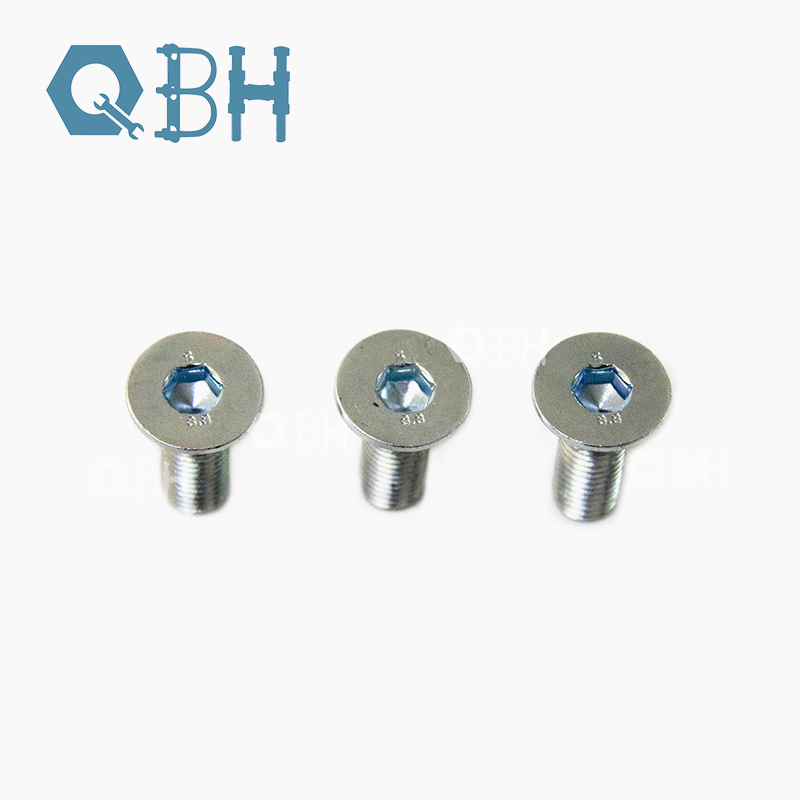
DIN 7991 Flat Head Socket Bolt is designed for applications where a secure threaded connection and a flush surface are both important. Its 90° countersunk head sits inside a matching countersink, reducing protrusion and leaving more usable space around assembled components. In this article, we examine how head geometry, alloy steel materials, strength grades, thread configurations, and surface treatments affect joint design. At QBH®, we also consider the manufacturing and specification details that matter when selecting fasteners for industrial equipment, machinery, and precision assemblies.
Table of Contents
- How Does the DIN 7991 Head Design Improve Joint Performance?
- 5 Practical Benefits of Flat Head Socket Bolts in Joint Design
- Which Materials and Strength Grades Should You Consider?
- DIN 7991 Flat Head Socket Bolt Specifications
- How Does Surface Treatment Affect Fastener Performance?
- Where Are DIN 7991 Socket Bolts Commonly Used?
- What Should You Check Before Selecting DIN 7991 Bolts?
- Frequently Asked Questions
How Does the DIN 7991 Head Design Improve Joint Performance?
In mechanical assembly, the bolt head can affect more than appearance. It determines how much space a fastener occupies, whether adjacent components can move freely, and how the connected surfaces fit together. This is why we often recommend considering a DIN 7991 Flat Head Socket Bolt when a project requires a low-profile fastening solution.
Unlike conventional hex bolts with raised external heads, DIN 7991 fasteners feature a flat countersunk head and an internal hexagon drive. The standard 90° countersunk geometry is designed to fit into a matching countersunk hole. When the hole angle and head dimensions are properly matched, the bolt head can sit flush with or slightly below the surrounding surface.
For example, when fastening two steel plates in a machine housing, a protruding bolt head may interfere with a sliding component or reduce the available clearance. A countersunk socket bolt can eliminate this interference without requiring additional space above the joint.
At QBH®, we pay attention to head dimensions, thread specifications, material selection, and surface finish because these details determine whether a fastener fits the actual assembly rather than simply matching a product name on a drawing.
5 Practical Benefits of Flat Head Socket Bolts in Joint Design
1. Flush Installation Saves Assembly Space
The countersunk head allows the fastener to sit within the prepared hole instead of extending above the component surface. This is useful in compact machinery, equipment covers, sliding assemblies, and metal panels where clearance is limited.
2. A Smooth Surface Reduces Mechanical Interference
Exposed bolt heads can catch on nearby parts, tools, or moving components. A properly installed flat head socket bolt creates a smoother external surface, reducing the risk of interference during equipment operation and maintenance.
3. Internal Hex Drive Supports Compact Assembly
The hexagon socket allows installation with an Allen key or hex bit. Unlike an external hex head, it does not require a wrench to grip around the outside of the fastener. This is particularly useful when several bolts are positioned close together or inside narrow machine structures.
4. Multiple Strength Grades Support Different Requirements
Different mechanical assemblies require different fastening properties. QBH® offers product configurations with listed strength classes of 4.8, 6.8, 8.8, 10.9, and 12.9. However, we do not recommend selecting a grade based on tensile strength alone. The countersunk head geometry and internal socket also affect the load capacity of the complete fastener.
5. Material and Coating Options Improve Application Flexibility
Alloy steel materials and different surface finishes allow fasteners to be selected according to mechanical loads and environmental conditions. For example, zinc-plated finishes can be considered for general moisture exposure, while zinc-aluminum coatings may be preferable when longer corrosion protection is required.
Which Materials and Strength Grades Should You Consider?
Material selection directly affects the mechanical performance, manufacturing process, and service life of a fastener. For our DIN 7991 Flat Head Socket Bolt range, the listed material options include 35K, 40Cr, 35CrMo, and SCM435. Each material has different characteristics, so the final choice should reflect the required strength class, heat treatment, dimensions, and operating conditions.
| Material | Key Characteristics | Typical Considerations |
|---|---|---|
| 35K | Carbon steel commonly used in fastener manufacturing | Suitable for selected general-purpose fastening requirements, depending on heat treatment and specified grade |
| 40Cr | Chromium alloy steel with good hardenability | Used where higher strength and mechanical performance are required |
| 35CrMo | Chromium-molybdenum alloy steel | Considered for demanding mechanical fastening applications |
| SCM435 | Chromium-molybdenum alloy steel commonly used for high-strength fasteners | Suitable for applications requiring controlled mechanical properties after appropriate heat treatment |
Strength class is another important consideration. The following table summarizes the available classes listed for this product range. Actual mechanical properties must be verified against the applicable material and product standards.
| Property Class | General Application Consideration |
|---|---|
| 4.8 | General mechanical fastening with moderate strength requirements |
| 6.8 | Applications requiring higher strength than common low-strength fasteners |
| 8.8 | Commonly specified for structural machinery and industrial equipment connections |
| 10.9 | Higher-strength fastening applications subject to head and standard limitations |
| 12.9 | Selected high-strength applications requiring careful verification of complete fastener load capacity |
One point deserves attention: a higher property class does not automatically mean a countersunk bolt can withstand the same load as a conventional hexagon socket head cap screw of the same thread size. The reduced cross-section beneath the socket and the countersunk head geometry must be considered during joint calculations.
DIN 7991 Flat Head Socket Bolt Specifications
When evaluating a fastener for a new project, we recommend checking the dimensional range, material, manufacturing process, and delivery requirements together. The following specifications summarize the current QBH® product information.
| Parameter | Product Specifications |
|---|---|
| Product Name | DIN 7991 Flat Head Socket Bolt |
| Brand | QBH® |
| Place of Origin | China |
| Standard | DIN 7991 |
| Material | 35K, 40Cr, 35CrMo, SCM435, etc. |
| Size Range | M3–M64 (availability and applicable standard dimensions to be confirmed) |
| Production Process | Cold Forging ≤300 mm; Hot Forging ≤1000 mm |
| Strength Classes | 4.8, 6.8, 8.8, 10.9, 12.9 |
| Certification | ISO 9001 |
| HS Code | 7318159001 |
| Delivery Time | Within 30 days |
The listed M3–M64 range represents the supplied QBH® product range, not a claim that every size falls within the dimensional scope of DIN 7991. For reference, the traditional DIN 7991 dimensional range covers M3–M24. Larger sizes should be confirmed against the agreed drawing and applicable product specification before ordering.
How Does Surface Treatment Affect Fastener Performance?
Even when two bolts have identical dimensions and material grades, their surface treatments can make a significant difference in service environments. Moisture, humidity, chemical exposure, and maintenance conditions should all be considered before choosing a coating.
For our DIN 7991 Flat Head Socket Bolt configurations, the following surface treatment options are worth evaluating:
| Surface Treatment | Main Characteristics | Suitable Environment |
|---|---|---|
| Black Oxide | Provides a dark appearance with mild corrosion resistance | Dry indoor environments with appropriate maintenance |
| Zinc Plating | Provides a protective zinc layer against corrosion | General applications involving moderate moisture exposure |
| Zinc-Aluminum Coating | Offers enhanced corrosion protection compared with conventional zinc plating | Applications requiring extended corrosion resistance |
For projects exposed to humidity or outdoor conditions, we suggest reviewing the required corrosion resistance together with coating thickness, fastener dimensions, and the risk of hydrogen embrittlement. This is particularly important for high-strength alloy steel fasteners with electroplated coatings.
When corrosion performance is a critical requirement, salt spray testing can provide a useful comparison. For example, the QBH® product information lists up to 1,000 hours of salt spray resistance for the specified zinc-aluminum coating configuration under ASTM B117 testing. This result should be confirmed for the actual coating system and batch. Salt spray hours should not be treated as a direct prediction of service life in the field.
Where Are DIN 7991 Socket Bolts Commonly Used?
Because of their low-profile head design and internal hex drive, countersunk socket bolts are used in many assemblies where surface clearance and secure fastening are both important. We generally see the following application scenarios:
- Industrial machinery: Connecting machine covers, mounting plates, brackets, and equipment housings where protruding fastener heads could interfere with other components.
- Automation equipment: Securing compact mechanical modules, positioning plates, and machine frames with limited installation space.
- Metal fabrication: Joining sheet metal components and machined parts where a smooth external surface is preferred.
- Automotive equipment: Fastening selected brackets, panels, and mechanical components where the specified load and assembly conditions are suitable.
- Precision instruments: Securing covers and structural parts where compact dimensions and controlled assembly are important.
In these applications, the countersunk hole must be designed correctly. If the countersink is too shallow, the bolt head may remain raised. If it is too deep or poorly matched, the bearing contact area can be reduced. Either condition may affect the joint's clamping performance.
What Should You Check Before Selecting DIN 7991 Bolts?
From our experience in fastener production and supply, choosing a suitable bolt requires more than matching its nominal diameter and length. We recommend reviewing the following points before confirming an order.
1. Confirm the Countersunk Hole Dimensions
Check the head diameter, head height, countersink angle, and hole geometry. A standard 90° countersink should be matched with the corresponding bolt head dimensions to achieve proper seating.
2. Select the Correct Thread and Length
Confirm the metric thread diameter, pitch, and required engagement length. Coarse threads are common for general assembly, while fine threads may be specified for particular design requirements. Fine threads are not interchangeable with coarse threads, even when their nominal diameters are identical.
3. Verify the Required Mechanical Properties
Consider the joint load, tightening torque, substrate material, and installation method. For countersunk fasteners, the head's reduced load-bearing capacity must be included in the design assessment.
4. Match the Coating to the Operating Environment
Specify the expected humidity, chemical exposure, corrosion protection level, and any restrictions on coating thickness. For high-strength steel bolts, also review the applicable hydrogen embrittlement prevention requirements.
5. Confirm Manufacturing and Inspection Requirements
For customized orders, provide technical drawings or samples whenever possible. We recommend confirming dimensional tolerances, material certificates, mechanical test requirements, coating specifications, and inspection criteria before mass production.
At QBH®, we combine fastener production, product design, sales, and after-sales service. Since 2015, we have also participated in several fastener enterprises to expand product variety and improve supply flexibility. Our registered QBH® trademark, six fastener product patents, and ISO 9001 quality management certification support our ongoing work in fastener development and manufacturing.
For customers sourcing DIN 7991 Flat Head Socket Bolt products, we can discuss material options, size requirements, manufacturing processes, and surface treatments according to project specifications. Our goal is to provide practical fastening solutions with controlled quality and competitive supply options.
Frequently Asked Questions
1. What is a DIN 7991 Flat Head Socket Bolt?
A DIN 7991 bolt is a hexagon socket countersunk head fastener featuring a flat, typically 90° countersunk head and an internal hexagon drive. It is designed to sit flush with a suitably prepared countersunk surface, making it useful for compact mechanical assemblies and applications requiring reduced head protrusion.
2. What is the difference between DIN 7991 and a standard hexagon socket head bolt?
The main difference is the head design. DIN 7991 uses a countersunk head that fits into a prepared countersink, while a standard hexagon socket head bolt has a cylindrical raised head. The countersunk version saves external clearance, but its head geometry can reduce load-bearing capacity.
3. Which materials are available for QBH® DIN 7991 bolts?
Our listed material options include 35K, 40Cr, 35CrMo, and SCM435. The appropriate material depends on the required strength class, heat treatment, dimensions, and operating environment.
4. What sizes and strength classes can QBH® supply?
The listed product size range is M3–M64, with strength classes 4.8, 6.8, 8.8, 10.9, and 12.9. Availability, dimensional compliance, and mechanical properties should be confirmed against the specific order drawing and applicable standard.
5. Can DIN 7991 bolts be used in high-vibration applications?
They can be used in suitable mechanical assemblies, but the thread type, preload, joint design, and locking method must be evaluated. Fine threads may be selected for certain design requirements, but they do not automatically prevent loosening. Where vibration is significant, an appropriate locking solution and assembly validation are recommended.
6. Which surface treatment is best for corrosion resistance?
The choice depends on the operating environment and required corrosion performance. Zinc plating is suitable for many general applications, while zinc-aluminum coatings can provide improved salt spray resistance. Black oxide is generally more appropriate for dry indoor environments unless additional protection is applied.
7. What information should be included in a DIN 7991 bolt inquiry?
We recommend providing the nominal diameter, length, thread pitch, material, property class, surface treatment, applicable standard, quantity, and technical drawing if available. These details help us evaluate manufacturing feasibility and provide a more accurate quotation.
Conclusion: A well-designed joint depends on the relationship between fastener geometry, material strength, thread engagement, and installation conditions. DIN 7991 Flat Head Socket Bolts offer a practical solution when flush installation and compact assembly are important. At QBH®, we focus on matching these technical requirements with suitable manufacturing and supply options to support different industrial fastening projects.
Technical References: ISO 10642:2026 – Hexagon Socket Countersunk Head Screws | International Organization for Standardization (ISO)